RETRO SOUP

DSCN2070

Remember when all that women – it was taken for granted that it was always women – supposedly had to do to prepare dinner was open some cans of this and that, some boxes of frozen whatevers, and presto! dinner practically made itself.  This is sort of an homage to that time, though I’ll remind you that I did make my own chicken stock.  And any resemblance to June Cleaver is purely accidental.

I work with a lovely, kind, and generous woman whose son and daughter-in-law welcomed their first baby a few days ago.  I have a day off and some time on my hands, the weather is cool-ish and breezy with a pattering rain falling, and I need to finish editing a writing project, which is always more pleasant when there is a good aroma in the air.  All of which adds up to soup:  dinner for me, and lots to share.

I roasted a couple of chickens recently.  Stock made from the deeply colored skin and carcasses, along with the contents of the week’s stock bag, is a treasure to have in the freezer.  Simmered gently overnight, by morning it reduces to a heady concentration of flavors.  I pour it through a colander to remove the large solids.  (Please, oh please remember to set a large bowl beneath the colander!  You might not weep, but you’ll surely shriek  if the gorgeous golden stock runs down the drain.  As I did once.  Only once.)  Then I strain the stock through a fine-mesh sieve (I set it over the original pot to minimize washing up) to remove the fine particulates.  Stock should be a crystal clear jewel-like color.  Once it has been chilled, any fat rises to the surface and you can scoop it away with a slotted spoon.  I wind up with nearly a gallon of golden goodness that I divide among quart-size containers and store in the freezer for a day like today.

You know the cupboard that you dread opening because you know something is going to fall out on you?  Well, I finally launched an expedition to the back of it the other day.  I’m not going to be buying any size, shape, color, or ethnicity of noodle for a long time.  Beans:  black, cannellini, garbanzo – call me; I’ll make you a great deal.  And tomatoes!  Canned tomatoes should be always be a pantry staple, but come on, seven cans?  Have they been reproducing in the night?

If you have some leftover chicken meat, chop it up and add it as well.  The beans and other vegetables below are more a guideline; I mainly wanted to pack the soup with as much goodness as possible.  Feel free to use whatever reproduces most abundantly in your pantry.

RETRO SOUP

Olive oil

2 tablespoons butter

2 yellow onions, small dice (1/4″)

6 cloves garlic, smashed and minced

4 carrots, peeled, medium dice (1/2″)

4 stalks celery, trimmed, medium dice (1/2″)

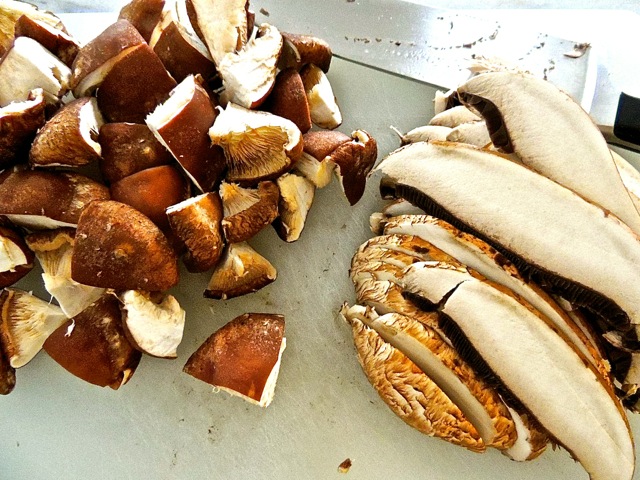
Mushrooms, brown or white, stemmed (save the stems for stock), quartered, as many as you like

2 teaspoons dried tarragon

Sea or kosher salt and pepper

2 quarts chicken stock (if you don’t have any of your own on hand, use a good organic one)

2 28 ounce cans diced tomatoes and their juice

2 14.5 ounce cans beans (use whatever you like – I used one of black beans and another of garbanzos), drained and rinsed

1/2 half pound frozen corn kernels

1/2 pound frozen peas

Juice of 1 lemon

1/2 box of your favorite shape of pasta

  1. Never wash mushrooms.  A mushroom is like a sponge, a wet sponge.  The reason for sautéing them, or any vegetable for that matter, is to drive off some
    Mushrooms in need of some cleaning

    Mushrooms in need of some cleaning

    of their water so that it is cooked away, and the flavor is concentrated.  If you wash a mushroom, you’re only getting it more wet.  That said, obvious dirt needs to be removed, obviously, so wipe the mushroom caps gently with a dry paper towel.  Quarter the large ones and halve the smaller ones.

  2. Film the bottom of a large soup pot with olive oil.  Add the butter.  Warm the pot over medium-high heat.  When butter has melted and begins to bubble, add the onion and a pinch of salt.  Sauté until the onion has softened.  Add the garlic, mushrooms, and tarragon; cook just until the mushrooms begin to soften, 3 or 4 DSCN2064minutes.  They want to stay plump because their texture in the final soup will be so satisfying.  Next, add the carrots and celery (I like to dice them on a diagonal because they look pretty on a spoon) and sauté until the celery appears translucent and the carrots are warmed through.
  3. Add the canned tomatoes and the rinsed and drained beans.  You can toss in the peas and corn when still frozen – just eyeball about half of a one-pound bag.  Add your chicken stock and stir everything together.  Cover the pot and bring the soup to a simmer, then reduce the heat to where it continues to simmer gently.  Remove the lid so that flavors can concentrate.  Simmer the soup for about an hour.
  4. Cook the pasta of your choice separately.  If you add it to the soup to cook, it tends to absorb too much liquid and overcooks to a mushy consistency.  Be sure to cook it a good 2 or 3 minutes less than the package calls for; after you’ve drained it, you’re going to add it to the soup and let it simmer there for a few minutes to absorb some of its flavors.  I used farfalle because it always makes me smile.
  5. Before serving, serving, add the lemon juice and season the soup to taste with DSCN2072salt and pepper.  Your soup is not going to taste like lemon soup; rather the lemon adds a brightness to the ensemble of flavors, making them all pop a bit more on your palate.  That’s a good trick to keep up your sleeve when cooking lots of dishes.
  6. You can garnish the soup with some shaved Parmesan, or some shredded cheddar.  I like to sprinkle some thinly sliced scallions on top after I’ve filled a bowl.

DSCN2075

Leftovers freeze beautifully.  To re-serve, let thaw in the refrigerator, then let sit at room temperature for a half hour or so.  Reheat it gently in a covered pan so that you don’t overcook the pasta.

DSCN2065

I wish you a rainy, soup-making day soon.

Posted in RECIPES, Soups, Leftovers, SUNDAY SUPPER, WEEKNIGHT DINNER | 2 Comments

SUNDAY SUPPER: ROAST CHICKEN

DSCN2029

For the past few months I have had the incredible good fortune to have taken a writing class co-taught by one of my favorite writers and another gentleman who has become one of my favorite professors, one Professor David Craig, a gently intelligent teacher with one of the most lovely speaking voices I have ever heard.  The fact that Tim Cahill is considered a travel writer is incidental; if he wrote the phone book, it would be fascinating.  We would know how R. Pecarina and L. Pecinovsky found their way to our neck of the woods, how E. Sister Kugi came by her lovely name, and if any of the 15 Helgesons are related to each other.  He would likely travel to Norway to track down the common ancestor of the Nelsons who occupy most of page 125.  And I know he would have some fun with R. Nixon.

At one point during a conversation, I mentioned that I wrote a food blog and gave its title.  He said that he is also a solitary cook, and that he can roast a chicken and grill a steak.  ”Nothing wrong with that,” I replied.

A roast chicken is one of life’s deeply gentle pleasures.  I remember during the recent seriously lean financial years, at least once a year every single damn cooking magazine, including the late great Gourmet, featured not only roast chicken, but made it the cover story.  And to a one, it was as though they had invented it themselves.  It drove me crazy.  At one point, I yelled out loud, “Roast effing chicken isn’t exactly Nobel-quality thinking!” and I began to boycott every issue that mentioned chicken in any form.  I also didn’t exactly say “effing.”

If one can roast a chicken, one can eat well for many days in many ways.  I always tell classes that it takes as long to roast two chickens as it does one.  With two, the goodness is that much greater, and it’s a lovely way to bring a weekend to a close.  The first, of course becomes dinner that night.  The rest of it, and all of the meat from the second are pulled off, packaged in ziplock bags, and nestled in the freezer.  Burritos, tacos, sandwiches and salads, are just a few of the lunches and dinners waiting in the wings.  Soup, ah soup!

The skin and all the bones go into a stockpot along with some onions, carrots, celery.  I add in the contents of the stock bag I’ve collected in the refrigerator during the week:  mushroom stems, thyme and rosemary stems, tomato ends, clean onion skins, garlic peels.  I cook it down slowly overnight and by morning the scent rouses me before my alarm clock goes off.

Never read anything by anyone who thinks you’re stupid.

ROAST CHICKEN

I’m going to tell you how I like to roast a chicken.  It is far from the only way; it may not even be the best way, but it is my favorite way.  It’s also how Marcella Hazan roasts a chicken, and that’s all I need to know.

YOU WILL NEED:

2 whole chickens, about 4 to 5 pounds each (I prefer organic because I have a good idea of what they haven’t been fed)

2 large or 4 small lemons (I used the last of the season’s Meyer lemons, and they tend to the small side)

1 full head of garlic broken into individual cloves

Olive oil

Sea or kosher salt and fresh ground pepper

1.  Preheat your oven to 400 degrees.

2.  I don’t use giblets in stock because the liver, especially, gives it an off flavor.  I do put the neck in the roasting pan and add it to the stock.  I cook the giblets in a skillet and divide them among the very happy dogs and cats.

3.  Set the chickens in a roasting pan, preferably one that can transfer to the stovetop.  Divide the garlic cloves (you don’t need to peel them) between the two, and place them in the cavities.DSCN2019  Next, pierce the lemons all the way around with a DSCN2017fork so that they release their oils and juices.  Place them in the cavities.  To truss or not to truss?  Many recipes will tell you to truss the legs together, also wrapping the string around the wings to secure everything together so that all parts roast evenly.  Well, I consider the wings as stock material.  And frankly, I hate to truss.  I don’t do it well, it annoys me, and the plump organic chickens I buy hold their shape so well that I find trussing is unnecessary.  So there.  Truss or not, as you please.

4.  If you like crispy skin, don’t oil the chickens.  I don’t like chicken skin at all, save for its flavorful contribution to stock, so I pour olive oil over the breasts and massage it all over the birds.  Then I liberally salt and pepper them.  My favorite salt is a coarse, grey French sea salt from the Camargue.  I am capable of being unbelievably stupid: on my most recent return flight from France a couple of years ago, I had to pay 50 euros for the extra weight of all the sea salt I brought home; I discovered I can buy the exact same salt here in town at World Market for $4.95!   Good grief.

DSCN2022

5.  Set the roasting pan in the oven.  Within a half hour, wonderful aromas will begin to perfume your kitchen.  Think about what you want to serve with your chicken.  Potatoes?  Rice?  Asparagus is just coming into season.  Perhaps light the grill, trim the spears of their tough ends (and save them for the stock pot!), toss them in some olive oil, sea salt and pepper, grill them for just a few minutes, and serve them with some lemon juice squeezed over them.

6.  Roast your chickens until a thermometer reads 165 degrees. It will probably take about an hour and a half.   The USDA governs food safety laws in this country, and while they pertain to restaurants and the like, their guidelines are excellent for any home cook to know.  Salmonella rears its ugly head now and then, and in order to guard against it, all poultry (basically if it has wings, it’s poultry) should be cooked to 165 degrees.  Where to take the temperature?  Would you believe that I’ve actually seen recipes that instruct taking it at the breast?  The thinnest, least dense area.  The area that is exposed most directly to heat.  No, don’t do that.  Find that meaty secluded spot to the inside of the thigh where it verges toward the back and insert your thermometer there.  Don’t let it touch the bone.  When that spot registers 165 degrees, your chickens are done.

Close enough to 165

Close enough to 165

7.  Remove your bronzed beauties from the oven and cover them with a sheet of foil followed by a nice, heavy bath towel.  Let them rest for 15 minutes.  Have you ever cut into a turkey and had fluid gush out of it?  You didn’t let it rest.  The rest period allows water that was squeezed out of the cells during the roasting process, because the stress of heat causes cell walls to contract, squeezing water to the outside.  You can’t eat the thing raw, right?   So you have no choice but to cook it.  But by allowing it to rest while still retaining its warmth, the cell walls relax, they wipe their brows and say, “Whew!  That’s over!”  Water roaming around on the outside reinflates the cells, and you have a tender, more juicy piece of meat.

And you look like a brilliant cook.

Even the breast is perfectly juicy and tender!

Even the breast is perfectly juicy and tender!

Posted in DO YOU HAVE WHAT IT TAKES?, Entrées, Gluten-free, Leftovers, Meats, RECIPES, SUNDAY SUPPER | Tagged , , , , | 8 Comments

MEATLESS MONDAY: QUINOA CAKES

Image

Quinoa is one of those perfectly perfect foods:  it’s high in protein (8 grams of protein per 185 gram serving – about 6 ounces), high in fiber (5 grams per serving), and best of all, it is a complete protein; it contains all amino acids necessary for life.  All by itself.  Compare that to an average white pasta which contains 7 grams of incomplete protein per serving, meaning that something must be added to it in order to complete the protein complement.  Wheat plus dairy creates a complete protein, for example.  Think Pasta Alfredo.  Pasta contains just 2 grams of fiber per serving (am I safe in thinking we’re all clear on the importance of fiber in our diet?), though its carbohydrate content is comparable to that of quinoa – 42 grams for pasta vs. 39 for quinoa.  But here’s the hitch:  a serving size of pasta is considered 2 ounces.  While that’s probably pretty reasonable, all things considered, who can actually restrict oneself to 2 ounces of pasta?  Not I.  It’s so good I just want more. And more.

For some time I thought that something as all-around perfect as quinoa just couldn’t be good. Remember the granola craze when it first became one?  Please, I’d rather chew gravel.  But I was wrong about quinoa.

As with practically any food, there is the right way to cook it and the wrong way.  Overcook it, and it will taste like any overcooked grain:  like mush.  But cooked just enough, its texture has a subtle crunch that is enormously satisfying, similar to perfect al dente pasta.  Only you can eat a lot more of quinoa, and be better to yourself at the same time.

QUINOA CAKES

Makes 6 to 8 cakes

_____________________________________________

First, a note about the quinoa.  It is available in white, red, black, and a combination of all 3 known as “rainbow.”

Image

I used the latter because it is so lovely.  When quinoa first became a fad, it was recommended that it be thoroughly rinsed before cooking.  The hulls are naturally coated with a substance called saponin which is bitter, hence, birds avoid it.  In recent years, though, most quinoas are pre-polished which obviates rinsing.  Nonetheless, I find that if I don’t give it a rinse in a strainer under cold water, there is a bitterness remaining after cooking it.  So do give it a quick rinse.

2 cups water

1 teaspoon salt

1 cup quinoa

1/4 cup barley flakes

2 tablespoons buttermilk

8 mushrooms, thinly sliced, then diced

1/2 yellow onion, small dice

2 stalks celery, small dice

2 cloves garlic, minced

Pinch of red pepper flakes

Olive oil

2 whole eggs

Sea or kosher salt and pepper

Your favorite eggs, cooked

2 scallions, 1/4” slices

  1. Bring to a boil the water and salt.  Add the quinoa, cover the pot, and reduce heat to a simmer.  Cook for 12 minutes.  There may be some water remaining.  That’s fine; simply pour the quinoa through a fine-mesh strainer and allow to cool while you prepare the vegetables. When you taste the quinoa, it should be a bit undercooked and have a touch of firmness to it.  Remember, you’re going to cook it again after you shape the cakes.Image
  2. While the quinoa is cooking, measure the barley flakes into a large mixing bowl and add the buttermilk.  Stir to blend.  Warm in the microwave for 15 seconds, then allow to sit.  Barley flakes are available in most any natural foods store, somewhere in the vicinity of rolled oats.  If you can’t find them, feel free to substitute rolled oats, but be sure to avoid the instant or quick-cooking varieties.  Along with the whole eggs, the barley (or oat) flakes will help bind the cakes together, and if you use instant ones, they will break down too much to be of any use.
  3. Film the bottom of a skillet with olive oil and warm it over medium heat.  When hot, add the mushrooms and a touch of salt.  Since they are diced small, they should shed their water relatively quickly, say in about 3-4 minutes.Image  When you can’t see water boiling away any longer, add the onion and sauté until softened, about 2-3 minutes.  Add the celery, garlic, and red pepper flakes; sauté until the garlic is fragrant.  Don’t overcook the celery, as it wants to bring a subtle crunch to the mix.
  4. Transfer the vegetables to the mixing bowl containing the barley flakes and buttermilk.  Add the cooled quinoa, and stir to blend everything together.  Taste the mixture and season as you wish with salt and some grinds of pepper.  Crack the eggs into the bowl and again stir to blend.
  5.  Film the bottom of the same skillet you used previously with olive oil and again warm over medium heat.  When hot, use a large spoon to drop batter into cakes about 3″ in diameter and 1/2″ thick.  Don’t crowd them.  Cook until each side is beautifully browned and forms a tender crust, about 3-4 minutes each, turning them over gently.
  6. Serve with one or two of your favorite type of eggs on top.  I’ll take mine poached, thank you.  Garnish with scallions.Image

If you have leftover batter, go ahead and fry it up.  Wrap the cakes individually in plastic, then seal them in a zip lock bag before freezing them.  What a wonderful surprise to discover on one of those nights when you need to pull a rabbit out of the so to speak hat.

Friends, it’s been a long hiatus.  At times a difficult one, but ultimately productive on many levels, with lots of stories to come.  In the meantime, it’s good to be back.

Posted in Breakfast, Entrées, Gluten-free, Leftovers, Meatless Monday, RECIPES, Side Dishes, Vegetarian | Tagged , , , | 14 Comments

WHAT A SURPRISE

On the lovely website known as Food52, which you all should visit frequently, one of my past recipes was chosen as a Wildcard Winner.  From time to time, the editors look over recipes which were submitted to prior contests and passed over for any sort of designation, and find buried treasures.  I am so honored to have a recipe that was discovered as one.   P.S. I’m known there as boulangere.

Posted in RECIPES | 8 Comments

CHANGE IS GOOD

Leaves changing color on my lovely linden tree, bearing one of the few berries the birds have left behind

I’ve been out of touch for a while.  I was very touched by how many of you wrote (I’m just now catching up on all your sweet messages) or called to see what was up.  Karen in Australia wrote to Suzanne in New York to get my phone number, and early one morning on my way to work, I answered a call to hear that beautiful, broad Australian accent say, “Okay, so you ARE there!”

Yes, I was here, I was fine, but my former computer had died.  One evening just before bed (which for me is before the chickens head to roost), I was reading a Kindle book on said computer because I had recently dropped the Kindle device, as one refers to electronics these days, on its head one too many times, and it had given up the ghost.  I had my customary cup of green tea to hand when Poppy the dog raised her paws to my knee and her head to my elbow, and tea sloshed over the keyboard.  What’s that new show on television where suddenly the lights go out everywhere?  It was a mini version of that, without the crossbow and sinister men on horseback.

I’d been thinking new computer thoughts lately anyway, though one usually prefers to make such choices rather than have them forced.  Fortunately, I’d already decided which model I wanted.  I ordered it. And then I waited.  And waited.  There was a text message saying it was in Alaska.  Alaska?!  Was it going fishing and going to bring me some salmon?  And halibut?  No.  It was gradually making its way from Thailand.  Out of stock in California, it was coming direct from the factory in Thailand.  Seriously, out of stock in the continental U.S.?

Whatever.  All told, I was incommunicado for about 2 and-a-half weeks, which seemed like sort of an eternity at first.  I experienced serious computer withdrawal.  On a normal day, I’d stumble into the kitchen around 3:00 a.m., and automatically head for the computer to boot it up, then turn to start water for coffee, add grounds to the French press, and by then the bright screen would beckon me.  The first day sans computer, I started toward it, and froze.  For a second I didn’t know what to do.  That slosh of tea had shifted all my bearings.  I felt a headache coming on.  But I managed to get coffee made, and the day progressed, if oddly.  I was quite conscious of something being missing.  The headache persisted.  I realized I was frowning as I made my way around the kitchen at work.  People began asking if something were wrong.  I explained that there had been a death in the family.

The next day fared better.  I was able to walk a straight line to coffee set-up, and when it was done, picked up an actual physical book, and got back in bed for a few minutes.  It was a delicious start to the day!  My bedside light was a small beacon in the still pitch darkness, my bed was still warm, the house utterly quiet.  My headache was gone.  Only the dogs were perplexed and unable to relax back into their beds.  They are border collies, and any change in routine causes them to furrow their brows and stare at me, awaiting a return to normalcy.

Ultimately, it was extremely freeing.  Yes, it was an inconvenience being disconnected, but there was absolutely nothing I could do about it.  And sometimes that’s a good lesson to re-learn.

In the meantime, even the dogs have adapted to the new morning routine.

Posted in STORIES | 23 Comments

MINI FRUIT TARTS

These were high on my list when I kept an eye out for cherry vendors on the way home the other day.  I pulled a disk of flaky pie dough from the freezer last night and let it thaw in the refrigerator overnight.  I had some goat cheese looking for a home, and lined the bottom of the tarts with some crumbles of it.  The tarts were done in time for Sunday afternoon tea and a sit-down in the shade with a book.  They would be heavenly served warm with a scoop of ice cream, too.

I had an abundance of apricots and cherries, but use whatever fruit you have.

MINI FRUIT TARTS

Makes 6 tarts

1 disk flaky pie dough

4 ounces goat cheese, or ricotta

2 tablespoons honey

3 apricots

9 cherries, pitted

Beaten egg

2 tablespoons sugar

  1. Preheat oven to 425 degrees.
  2. Flour your work surface, then flour the surface of your dough.  Follow the rolling instructions here.  I used a plastic lid about 4 1/2″ in diameter as a cutting guide.  Roll the dough large enough and thin enough so be able to cut out 6 circles with a 1/2″ border around the edge of your form.  Use a sharp paring knife to cut the circles.
  3. Transfer the circles of dough to a baking sheet lined with parchment.  Distribute the crumbles of goat cheese among them.  Drizzle a teaspoon of honey over the goat cheese.  Arrange 3 slices of apricot on top of the honey and goat cheese, followed by 3 cherry halves.
  4. Fold the edges of the pastry in 1/2″, pleating as you go around.  Brush the pastry edges with the beaten egg, then sprinkle each with sugar.
  5. Bake at 425 for 15 minutes, rotate the baking sheet and reduce the heat to 375 for 5 minutes more.
  6. Remove from oven and allow to cool before serving.  They should be served at room temperature or slightly warm.

Enjoy an afternoon delight!

Posted in Desserts, Pies & Tarts, RECIPES, Vegetarian | 12 Comments

GRILLED VEGETABLE SALAD AND A DISCOURSE ON KALE

I find I’m in somewhat of a frenzy these days over the abundance of local fresh produce practically everywhere.  The farmers market, sure.  But driving home one afternoon last week (a distance of perhaps 3 or 4 miles), I passed no fewer than 3 roadside stands selling FLATHEAD CHERRIES!  TREE RIPENED!  I counted because I needed some for a couple of baking ideas I’ve been ruminating about, and was hoping to find one.  I stopped at the one I could turn into most easily.

The Saturday farmers market today was overflowing with beans.  Green beans, yellow beans, purple beans, all great, big, fat beauties.  With temperatures in the high 90s and low 100s, boiling water to blanch is not in the cards.  Everything about this salad is happening on the grill.

I need to digress here for a moment to talk about kale.  Because I added some to the salad.  But I want to be clear:  please do not confuse me with one of those who has pledged my soul and my first-born to the Better Living Through Kale Society.  I read an essay in the most recent Food & Wine by Katherine Wheelock on the very subject of the everywhere-ness of kale.  I was tempted to write her a letter beginning with, “I think I love you!”  I restrained myself, instead working out my thoughts and feelings here.

To be fair, her essay asked the question, “Is Seasonal Eating Overrated?”  Her quarrel, though, was not with the philosophy of seasonal eating; rather, it was with the reductionist pattern it tends to engender.  Which brings us to kale and its ubiquitousness.

Kale is the new oat bran.  Remember oat bran?  It was in everything and it was going to cure everything.  Okay, maybe not everything, but I trust you’re getting my drift.  Kale has a reach oat bran could only dream of.  It’s everywhere.  It’s in everything.  And the implication is that everyone should be eating it.  At every meal, and for snacks in between.  Which anyone could very easily do.  Enter kale into the Search field on any - any – food website, and you’ll find literally hundreds of ways to include it in breakfasts, soups, salads (“massaged” kale salad, oh please), entrées, side dishes, and yes, snacks.  The only course so far exempt seems to be dessert.  So far.

The guilt lies not with kale.  It’s a perfectly nice vegetable.  I’ve grown it in gardens and enjoyed its hardiness and abundance.  And when its season was over, we moved on to other seasonally appropriate vegetables.  But lately we’ve become positively myopic over kale.  If I see one more recipe for it, I swear I’m going to start throwing things.  That said, yes, I included it in this salad, and yes, I’m getting to the point.

I always cruise through the produce room at Costco just to see if there’s anything new and interesting.  Portions are usually too large for me, but there are a few things I routinely buy there:  carrots, mushrooms, grape tomatoes.  And that day, kale, a 1.5 pound bag of organic, washed baby kale.  I am trying hard to minimize the amount of unconsumed food I end up throwing away, so I contemplated it carefully.  Kale is a good keeper, but I wanted to be sure I could and would use it up.  When it’s gone, it will be a while before I buy another because I love greens, really love them, and variety is the proverbial spice.

GRILLED VEGETABLE SALAD 

In addition to beans, I also found tender sweet corn and some gorgeous red onions at the farmers market.  How can you pass up onions that call themselves Candy Apple Reds!

1 pound mixed beans, or green

1 medium or 2 small red onions

Corn from 3 ears (or 1 cup frozen, thawed)

1 or 2 handfuls baby kale left whole, or several large leaves cut into 1″ ribbons

Olive oil

Sea or kosher salt and pepper

Pinch of red pepper flakes

  1. Build a charcoal fire or light your grill.
  2. Remove just the stem ends of the beans, then cut them in half across the middle.
  3. Cut the onions into 1/2″ dice.
  4. Husk the corn and remove the kernels.  The easiest way to keep them from flying all over the kitchen is to lay the ears on your cutting board and remove the kernels with a knife by cutting in facets all around the cob.
  5. In a mixing bowl, toss together the beans, onions, and corn with about 2 or 3 ounces of olive oil.  Season with salt and pepper.
  6. When the fire is ready, set a grill pan on the grate to heat just as you would a skillet on the stove.  Toss a piece of one the vegetables into it as a test.  When hot, add the vegetables.  Spread them around gently with long tongs.  Flames will shoot up because of the olive oil dripping onto the coals; don’t worry, they’ll subside when you close the grill.   Close the lid of the grill, and damp down the upper and lower drafts.  Let the vegetables steam/smoke for 5 minutes.  At the end of that time, add the kale and again close the grail for about 2 minutes.  When the kale has wilted a bit, pour all the vegetables back into the bowl in which you tossed them.
  7. Back in the kitchen, add another ounce or so of olive oil along with a pinch of red pepper flakes.  Adjust salt and pepper if necessary.  The vegetable juices will blend with the olive oil, creating its own earthy dressing.  Allow salad to cool while you grill the rest of dinner.
  8. Refrigerate any leftovers.  Add some feta cheese for a lovely lunch.
Posted in Leftovers, Meatless Monday, RECIPES, Salads, Side Dishes, Vegan, Vegetarian | Tagged , | 4 Comments

PESTO (ALLA) GENOVESE

Dianna B. has waited patiently for a pesto recipe in which to use her bolting basil.  Here is my sister-in-law’s recipe, as promised.  Elly’s husband was native French, one of my favorite languages as well, so I suppose neither of us ever thought twice about the French-i-fied version of “alla.”   Whatever, it became our family’s gold standard against which all others were measured, and always found wanting.  The daughter, especially, has a pesto palate like no other.  When out, she’ll order it any way she can get it, then tip her head in careful consideration as she sums it up, “It was good, but not as good as Aunt Elly’s.”  Even when I made it at home, it was never mine; a question as to what was for dinner was answered, “Aunt Elly’s Pesto.”

I copied it into my recipe book exactly as Elly wrote it down for me.  When growing up in (then) rural Connecticut, the family had had an Italian housekeeper (Giovanna, I believe), whose husband helped their father, an artist, in his studio.  I recall my husband talking about her polenta, which she would cut with a length of picture-hanging wire, and I suspect she was also the root of Elly’s pesto recipe.

Oil assumes olive oil.  She’d use walnuts in a pinch, but pine nuts were preferred.  Food processors weren’t yet a glimmer in anyone’s eye, so she (and I for several years) made it in a blender, which worked just fine.  When she prepared it to freeze – and Elly, the prototypical frugal New Englander with a  garden the size of New Jersey, froze anything she could get her hands on – she omitted the Parmesan and instead added it to the steaming hot pasta as she tossed it with her pesto.

Buon apetito!

An addendum, in case you haven’t read through all the comments below:  that diligent task-master, Diana B., asked yet another of her questions which light up the blind spots of what I try to fashion as complete recipes carefully explained.   Do I measure the basil before or after chopping it?  I responded that I simply stuff (sort or more like pack them in, actually) whole leaves of both basil and parsley into a dry measuring cup.  Where pesto is concerned, close enough is close enough.

Posted in Meatless Monday, Pantry Dinners, Pastas, RECIPES, STORIES, Vegetarian | Tagged , | 13 Comments

SUMMER PRESENTS

Place the accent on “presents” where you will, the result is the same:  a burst of summer all wrapped up in a bundle of creamy crunch.  And they wrapped up a lovely surprise just this afternoon, turning up as a finalist in the current contest sponsored by Whole Foods Market Cooking, Raleigh, NC.  To gild the lily, I found myself paired with one of Panfusine’s lovely creations.  Please take a look at a website rich in information and ideas.  And vote as you wish.  Thank you so much.

An update . . . Panfusine’s delicious creation won, and deservedly so.  Thanks to all who took a look or voted!

Posted in Hors d'oeuvres, RECIPES, Vegetarian | Tagged , | 6 Comments

MEATLESS MONDAY: GRILL-ROASTED EGGPLANT CAPONA OVER ROASTED POTATOES

Just look at these beauties!  I almost don’t want to cook them; I’d rather cradle and caress them, they’re so perfectly smooth and ripe.  But cook them I will.  (Re-reading this, I’m anticipating a couple of responses:  some will be thinking I really should get out more; others will be right there with me.)

I’ve waxed on and on about the pleasures of produce and market offerings in both Italy and France last summer.  Whenever we went into a market to pick up cooking ingredients, picnic items, deodorant (long story for another time), we would wander the aisles in a state of wonder.  Olive oils, salts, cheeses, pastas – all would practically bring us to our knees.  And who knew cream came in so many forms!  I recently wrote about the amazing Sicilian Pestos; well, jewel-like jars of bruschetta toppings were just as jaw-dropping.  Spreading them on breads with cheese and salumi for a portable lunch wasn’t satisfying enough.  Nor was dipping into them with rustic crocante (as soon as I can bear to turn on the oven, I’ll get back to attempting to recreate their shattery-tender texture) before dinner in the evening.  We finally took to whisking them into our vinaigrettes for evenings’ sumptuous salads.

As fields are delivering up sun-warmed abundance, each trip to the farmers market these days brings happy memories flooding back and simultaneously sets the idea wheel spinning.  When I spied these gorgeous eggplants, I knew instantly what I was going to do with them.  This combination brings together flavors from some of our Italian favorites.  Yes, the grill will be making another appearance.

ROASTED EGGPLANT CAPONATA

Makes about 2 cups  Leftovers freeze perfectly

2 small or 1 large eggplant

Olive oil

Sea or kosher salt and pepper

2 small tomatoes, or 1 large

4 cloves garlic, smashed and peeled

2 small onions, or 1 large, 1/2″ dice

Olive oil

Sea or kosher salt and pepper

8-ounce jar of artichoke hearts packed in olive oil

1 dried pepper of moderate heat, rehydrated

2 anchovies

1 teaspoon capers

1/4 cup Kalamata or Niçoise olives

1 small handful Italian parsley, chopped

Zest and juice of 1 lemon

2 ounces olive oil

Sea or kosher salt and pepper

  1. Light your fire or start your grill.  Make the fire a big one – it has a lot of work to do.
  2. Trim the stem ends off the eggplants, then slice them in half the long way.  Brush the cut sides with olive oil and season lightly with salt and pepper.  When the fire is ready, lay the eggplants cut side down on the grate.  Close the lid, and damp down the top and bottom vents about half way.  Roast the eggplants until you can pierce them very easily with a sharp knife, about 5-7 minutes minutes.  Remove them from the grill and place them on a plate or a baking sheet.
  3. While the eggplants are grilling, set your dried pepper to rehydrate.  I used a mulatto, one of the peppers I received from Marx Foods.  It is described as having a mild heat level along with a chocolate/licorice flavor, both of which are perfectly accurate.  You could also use a puya chile, or half of a poblano.  I’m going for the deep tones you get from milder chiles, as opposed to the bright ones from hotter chiles.  Break the chile apart with your hands, and put it in a small bowl.  Fill it with boiling water to cover, and set a plate over the bowl to retain the heat.
  4. Open the bottom vent all the way, and set your grill pan on the grate to warm.  When you hear sizzle upon dropping a piece of onion or tomato onto it, add the tomato-garlic-onion mixture.  Use a pair of long tongs – the fire will be hot – to move the vegetables around gently as they warm through and begin to caramelize.  They’ll pick up deep flavors from drippings hitting hot coals.  When the onions have taken on some good color, remove the pan from the grill, and return the vegetables to the bowl in which you tossed them with oil.
  5. Now it’s time to roast the potatoes.

GRILL-ROASTED POTATOES

I like to use little gold-fleshed potatoes.  They’re tender as can be when cooked, and need only to be quartered or halved.

Aluminum foil

2 to 3 petite golden potatoes per person

1 or 2 cloves of garlic per person, smashed and peeled

Sea or kosher salt and pepper

Olive oil

  1. Tear off a sheet of foil about 12″ x 12″ for each person
  2. Wash and quarter the potatoes.  Set the potatoes in the center of each piece of foil.  Add the garlic to each, and season with salt and pepper.  Drizzle each with an ounce or so of olive oil.  Seal the packets by rolling the sides together over the center and folding in the ends several times.  Set them on the grill grate and close the lid.  Damp down the top and bottom vents about half way.  Allow potatoes to cook until you can pierce them easily through the top of the foil with a sharp knife.  Remove from the fire.

TO SERVE

All of the potatoes

Caponata

Parmesan cheese, as much as you like

Chiffonade of basil leaves

While the potatoes are roasting, prepare the caponata.

By this time, you should be able to comfortably hold the eggplant halves in one hand while you use a spoon to scoop the pulp with the other.  Drop the pulp into the bowl of a food processor.  Add the tomato-onion mixture.  Add the artichoke hearts and their oil, and drain the chile through a strainer and add it.  Add the anchovies, capers, lemon zest and juice.  Combine the ingredients by pressing the Pulse button.  You don’t want to purée this; rather, you just want to break the large pieces into smaller ones.  You definitely want to leave a good texture.  Finally, season to taste with salt and pepper.

Open each packet and arrange potatoes, garlic and oil on plates.  Top with spoonfuls of caponata.  Garnish with with some grated Parmesan cheese and chiffonade of basil leaves.

Posted in Condiments, Entrées, Meatless Monday, RECIPES, Side Dishes, Vegan, Vegetarian | 6 Comments